Due to its location at subtropical latitudes and proximity to the warm waters of the Gulf of America (formerly Gulf of Mexico) and western Atlantic, Florida has a climate characterized by hot, humid summers and mild winters. The combination of hot temperatures, moisture from the surrounding oceans, and sea breezes pushing inwards from both coasts means that thunderstorms are almost a daily occurrence in summer afternoons and evenings. Summer high temperatures typically range from the high 80s (°F) to the mid-90s, with the highest temperatures occurring in northern Florida and the lowest in the Florida Keys (1991–2020 averages). Winter temperatures vary greatly across the state, with south Florida experiencing mild temperatures and much cooler conditions occurring farther north. Average low temperatures range from the low 40s in northern parts of the state to more than 65°F in Key West. Precipitation also varies across the state, ranging from less than 45 inches in the Keys to more than 60 inches in western parts of the Panhandle.

Time series of observed and projected temperature change (in degrees Fahrenheit) for Florida from 1900 to 2100 as described in the caption.
Y-axis values range from negative 4 to positive 14 degrees. Observed annual temperatures from 1900 to 2024 show variability and range from negative 2.0 to positive 3.4 degrees. By the end of the century, projected increases in temperature range from 1.6 to 5.5 degrees under the lower emissions pathway, from 3.1 to 7.4 degrees under the intermediate pathway, and from 6.3 to 12.0 degrees under the higher pathway.
Annual average temperatures in Florida have increased more than 2°F since the beginning of the 20th century (Figure 1). The state has warmed rapidly since the 1970s, and 2015–2024 was the warmest decade on record. Although there has been no clear long-term trend in the number of very hot days (Figure 2a), nighttime warmth has increased significantly since the early 1990s (Figure 2b); the 5-year average for very warm nights for the 2020–2024 period was about triple the long-term average. While temperatures in Florida rarely exceed 100°F, the high humidity can cause heat index values to frequently rise above 105°F. Extended periods of extreme heat, especially when combined with high humidity, can result in heat-related illness among vulnerable populations and place excess stress on agricultural production, water supplies, and energy generation.
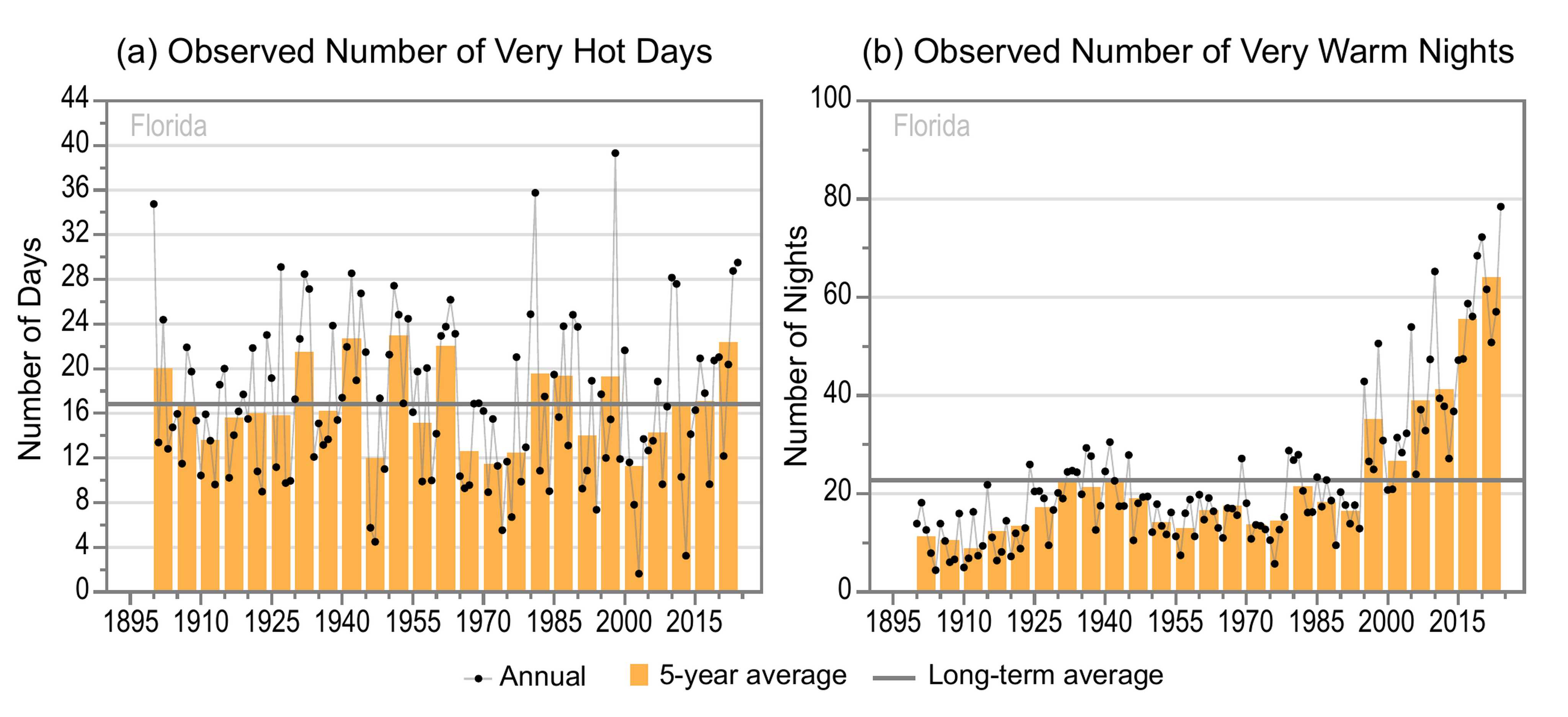
Two graphs of the observed annual number of (a) very hot days and (b) very warm nights for Florida from 1900 to 2024 as described in the caption.
Panel A: Very Hot Days
Y-axis values range from 0 to 44 days. Annual values show year-to-year variability and range from 1.6 to 39.3 days. Five-year values also show variability and are above the long-term average of 16.8 days for the 1900 to 1904 period, all near or below average between 1905 and 1929, highly variable between 1930 and 1964, and all below average between 1965 and 1979. Since 1980, 5-year values are mostly near or above average. The 1970 to 1974 and 2000 to 2004 periods have the lowest 5-year values at 11.5 and 11.3 days, respectively, and the 1940 to 1944, 1950 to 1954, and 2020 to 2024 periods have the highest 5-year values at 22.7, 23.0, and 22.4 days, respectively.
Panel B: Very Warm Nights
Y-axis values range from 0 to 100 nights. Annual values show year-to-year variability and range from 4.4 to 78.5 nights. Five-year values also show variability and are all near or below the long-term average of 22.7 nights between 1900 and 1994 but are all above average since 1995. The 1910 to 1914 period has the lowest 5-year value at 9.0 nights, and the 2020 to 2024 period has the highest at 64.0 nights.
During the cold season, extratropical cyclones and associated fronts are responsible for significant day-to-day variability in the weather. While the temperatures associated with cold waves are higher than in areas to the north, they can have major impacts on sectors adapted to the generally mild climate, such as agriculture. The annual number of freezing nights in some northern parts is about 30. Farther south, freezing temperatures are rare. Since 1948, Miami International Airport has dropped to 32°F or lower only 6 times and not once since 1989. Subfreezing air sometimes reaches as far south as Central Florida, causing major damage to citrus crops. The statewide average number of freezing nights has historically varied greatly from year to year; however, the number of such nights has generally been near or below average since the 1990s and consistently below average over the 2015–2024 period (Figure 3). A severe cold outbreak lasting more than a week in January 2010 resulted in more than $200 million in losses to the Florida citrus industry. On January 21, 2025, a historic snowstorm hit the Gulf Coast states. Snowfall totals across northern Florida ranged from about 4–10 inches, with Pensacola breaking its 2-day snowfall record with 8.9 inches. The storm caused significant impacts to crops and infrastructure, with the estimated costs of damages exceeding those caused by Hurricane Michael in 2018.

Graph of the observed annual number of freezing nights for Florida from 1900 to 2024 as described in the caption.
Y-axis values range from 0 to 24 nights. Annual values show year-to-year variability and range from 0 to 19.9 nights. Five-year values also show variability and are above the long-term average of 5.7 nights for the 1900 to 1904 period, mostly near or below average between 1905 and 1954, and all near or above average between 1955 and 1989. Since 1990, 5-year values are all below average except for the 2000 to 2004 and 2010 to 2014 periods. The 2015 to 2019 and 2020 to 2024 periods have the lowest 5-year values at 1.8 and 1.9 nights, respectively, and the 1975 to 1979 period has the highest at 11.4 nights.
Statewide total annual precipitation varies widely from year to year, ranging from a low of 40.3 inches in 2000 to a high of 72.9 inches in 1947 (Figure 4). Annual precipitation shows no long-term trend. Historically, the number of 4-inch extreme precipitation events has been highly variable, but it has been near or above average since the late 1990s (Figure 5). A recent extreme precipitation event occurred on April 12, 2023, when the Fort Lauderdale airport recorded more than 25 inches of rain in a 12-hour period.

Graph of the observed total annual precipitation for Florida from 1895 to 2024 as described in the caption.
Y-axis values range from 36 to 76 inches. Annual values show year-to-year variability and range from 40.3 to 72.9 inches. Five-year values also show variability, with no clear trend, and are mostly near or below the long-term average of 53.7 inches across the entire period. Exceptions include the 1945 to 1949, 1995 to 1999, and 2020 to 2024 periods, which have the highest 5-year values at 60.2, 55.9, and 55.9 inches, respectively. The 2005 to 2009 period has the lowest 5-year value at 50.2 inches.

Graph of the observed annual number of 4-inch extreme precipitation for Florida from 1900 to 2024 as described in the caption.
Y-axis values range from 0.0 to 2.0 events. Annual values show year-to-year variability and range from 0 to 1.6 events. Five-year values also show variability and are all near or below the long-term average of about 0.5 events between 1900 and 1944, mostly above average between 1945 and 1974, and all below average between 1975 and 1994. Since 1995, 5-year values are all near or above average. The 1990 to 1994 period has the lowest multiyear value at 0.2 events, and the 2020 to 2024 period has the highest at 0.7 events.
Drought is a persistent climate threat for Florida, resulting in water supply reductions, disruptions to agriculture, and increased risk of wildfires. In every decade since 1900, the state has been impacted by at least one severe (as defined by the US Drought Monitor) and widespread drought. Typically, the state exhibits a peak in wildfire activity from January to mid-June, a period when tropical moisture is reduced and occasional cold fronts usher in dry, windy conditions. In 2020, Florida experienced 2,381 wildfires, ranking tenth in the Nation that year for number of wildfires, with a total of 99,413 acres burned.
Florida also faces considerable threats from thunderstorms and tropical cyclones. The state experiences by far the highest frequency of thunderstorms in the United States, with central and southern portions of the state averaging more than 90 days per year with thunderstorm activity (1993–2018 average). Hurricanes frequently pass over the state: 100 hurricanes affected Florida from 1900 to 2024, including 22 storms since 2000, 9 of which were Category 4 or 5 hurricanes (Figure 6). On September 26, 2024, Hurricane Helene (Category 4) made landfall in the Big Bend region, bringing a devastating storm surge of 15 feet and maximum sustained winds of 140 mph, causing significant damage to structures and agricultural crops. About two weeks later, on October 9, Hurricane Milton (Category 3) made landfall along the west-central Florida coast, bringing rainfall totals as high as 20 inches and spawning dozens of tornadoes, including three rated EF3. Hurricane Ian (Category 4) made landfall in southwest Florida on September 28, 2022, leading to major flooding, widespread property damage, and 10 fatalities. Ian was the third-costliest US hurricane on record, trailing only Katrina and Harvey. In 2018, Hurricane Michael (Category 5) struck the Florida Panhandle, nearly destroying Mexico Beach and causing extensive damage to Panama City and Tyndall Air Force Base. Michael was the third Category 5 hurricane to hit Florida and the first since Andrew in 1992. In 2017, Hurricane Irma (Category 4) made landfall at Cudjoe Key, then crossed over the gulf and made landfall again in the Panhandle. The Florida Keys were heavily impacted, and near-historic levels of storm surge caused significant coastal flooding in Jacksonville. The number of landfalling Atlantic hurricanes is not expected to rise. However, hurricane-related rainfall rates, as well as the proportion of time the storms spend as major hurricanes, are projected to increase.

Graph of the total number of hurricane events for Florida from 1900 to 2024 as described in the caption.
Y-axis values range from 0 to 10 events. Five-year totals show variability across the period of record and range from 0 events for the 2010 to 2014 period to 9 events for the 2020 to 2024 period. Additional active 5-year periods include 1945 to 1949 with 8 events, and 1915 to 1919, 1925 to 1929, 1950 to 1954, and 1995 to 1999 with 6 events each.
Under the intermediate and higher emissions pathways, historically unprecedented warming is projected during this century (Figure 1). Even under the lower emissions pathway, most projections show annual average temperatures exceeding historical levels by the middle of the century. However, projections for all three pathways show a large range of potential temperature increases, and some projections for the lower pathway are comparable to recent observed values.
Under the intermediate emissions pathway, projections indicate increases in total annual precipitation by midcentury for Florida; however, these changes are not statistically significant (Figure 7). There is similar uncertainty in projections for seasonal precipitation, although models generally indicate statewide increases in spring, fall, and winter and both increases and decreases in summer. Increases in both the frequency and intensity of extreme precipitation events are projected, potentially increasing the frequency and intensity of floods.

Map of the contiguous United States showing the projected changes in total annual precipitation by the middle of this century as described in the caption. The state of Florida is outlined in black.
Legend values range from less than negative 10 to greater than positive 15 percent. Note: unless otherwise specified, projected values are not statistically significant.
Florida
Florida is projected to see increases in total annual precipitation of up 5 percent along the Atlantic coastline and the western portion of the panhandle and from 5 to 10 percent across the remainder of the state.
Contiguous US
Projected increases in total annual precipitation are as follows: up to 5 percent for most of the Southeast, as well as the central Midwest, central Great Plains, central West, and Northwest; and 5 to 10 percent for all of the Northeast, as well as portions of the Mid-Atlantic, Southeast, northern Midwest, northern Great Plains, and Pacific Northwest, with statistically significant increases in the 5 to 10 percent range for the Northeast, northeastern Midwest, and portions of the northern Great Plains and Pacific Northwest.
Projected decreases of up to 5 percent are expected across most of Texas, New Mexico, and Arizona, as well as southern California.
Periodic droughts, a natural part of the state's climate, are projected to be more intense, because higher temperatures will increase evaporation rates and soil moisture loss during dry spells, exacerbating drought conditions. Resulting decreases in water availability, compounded by population growth, will continue to increase competition for water and affect the region's unique ecosystems. Increased drought intensity, along with possibly decreased summer precipitation, is projected to increase the risk of wildfire occurrence and severity in Florida.
Florida is at considerable risk from sea level rise. On average, the state experienced about 6 inches of sea level rise between 1970 and 2020—similar to that for the contiguous US as a whole—and projections under the Intermediate sea level scenario show additional increases of about 9 inches by 2050 and 1.5 feet by 2070 (Figure 8). Across the five scenarios shown in Figure 8, the projected increases from 2020 to 2070 range from about 0.5 to 3.5 feet. Rising sea levels pose a threat to the state's coastal communities, infrastructure, and ecosystems. Increased inland flooding during heavy precipitation events in low-lying coastal areas is a threat, because mere inches of sea level rise have the potential to impair the capacity of stormwater drainage systems to empty into the ocean. Sea level rise presents major challenges to South Florida's existing coastal water management system due to a combination of increasing urbanization, aging flood control facilities, flat topography, and permeable limestone aquifers. Saltwater contamination of coastal groundwater reservoirs is another expected consequence of sea level rise.

Two time series of observed and projected relative sea level change for (a) the contiguous US and (b) Florida from 1970 to 2070 as described in the caption.
Y-axis values range from negative 1 to positive 4 feet for both graphs. Legends in both graphs denote sources of historical data and scenarios for projections. Line colors for historical data are black for tide gauge data and orange for satellite data. Line and shading colors for projections based on five scenarios are as follows: light blue, Low; medium blue, Intermediate-Low; dark blue, Intermediate; yellow, Intermediate-High; and dark orange, High.
Panel A: Contiguous US
Tide gauge and satellite data generally show increases but with year-to-year variability. Projected data show increases under all scenarios. Tide gauge values range from a minimum of negative 0.3 feet in 1976 to a maximum of positive 0.4 feet in 2023. Satellite values range from a minimum of 0.0 feet in 1994 to a maximum of 0.4 feet in 2023. Projected sea level median values (lines) for the Low scenario range from 0.3 feet in 2020 to 1.1 feet in 2070, compared to 0.4 feet in 2020 to 3.1 feet in 2070 for the High scenario. Likely ranges (shading) become wider over the period shown. The range of likely values in 2070 for each of the five scenarios are as follows: Low scenario, from 0.9 to 1.4 feet; Intermediate-Low, 1.2 to 1.7 feet; Intermediate, 1.5 to 2.2 feet; Intermediate-High, 1.8 to 3.1 feet; and High, 2.4 to 3.8 feet.
Panel B: Florida
The tide gauge line shows a gradual increase similar to that in the contiguous US graph, while the satellite line shows a lower increase. Future scenario lines show increases higher than those in the contiguous US graph for the High and Intermediate-High scenarios and similar increases for the Intermediate, Intermediate-Low, and Low scenarios. Tide gauge values range from a minimum of negative 0.3 feet in 1977 to a maximum of positive 0.5 feet in 2023. Satellite values range from a minimum of negative 0.1 feet in 1996 to a maximum of positive 0.4 feet in 2023. Projected sea level median values (lines) for the Low scenario range from 0.3 feet in 2020 to 1.1 feet in 2070, compared to 0.4 feet in 2020 to 3.2 feet in 2070 for the High scenario. Likely ranges (shading) become wider over the period shown. The range of likely values in 2070 for each of the five scenarios are as follows: Low scenario, from 0.9 to 1.4 feet; Intermediate-Low, 1.2 to 1.7 feet; Intermediate, 1.5 to 2.3 feet; Intermediate-High, 1.9 to 3.1 feet; and High, 2.5 to 3.9 feet.
Sea level rise increases the risk of high-tide floods associated with nuisance-level impacts. Such flooding occurs when one or more factors—sea level rise, winds, changes in ocean currents, full or new moons—push water levels above the normal high-tide mark. These events can damage infrastructure, cause road closures, and overwhelm storm drains. High-tide flooding has increased in all US coastal areas, with more rapid increases along the East and Gulf Coasts, and is likely to occur more frequently in Florida as global and local sea levels continue to rise. The number of high-tide flood days has increased at St. Petersburg, with the greatest number occurring in 2023 and 2024. Under both the Intermediate-Low and Intermediate scenarios, high-tide floods are projected to occur much more frequently in future years (Figure 9).
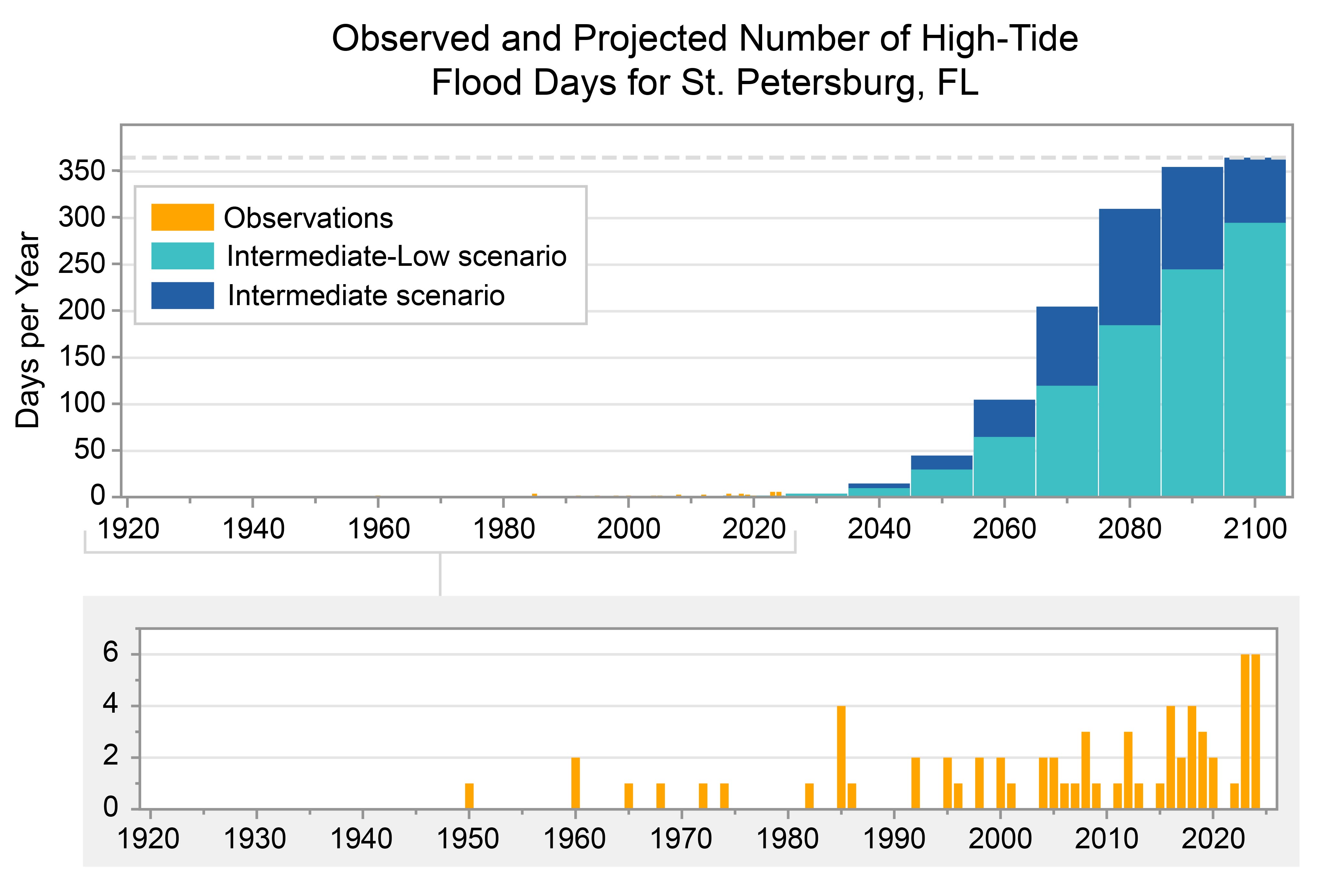
Graph of the observed and projected annual number of high-tide flood days at St. Petersburg, Florida, from 1948 to 2100 (top), including a magnified view of the observed data for the period 1948 to 2024 (bottom), as described in the caption.
A legend shows annual observations (orange bars) and projected 19-year averages (two-colored bars) for the Intermediate-Low (medium blue) and Intermediate (dark blue) sea level scenarios.
Bottom
Y-axis values for the magnified view range from 0 to 5 days per year. Following the first recorded event in 1950, high-tide flooding was sporadic until the early 1990s, often with gaps of at 5 years between events and annual values all below 3 days. Since 1992, high-tide flood days increased in frequency and number, and beginning in 2004, such days occurred every year except for 2010, 2014, and 2021. The record high of 6 days was recorded for both 2023 and 2024.
Top
Y-axis labels range from 0 to 350 days, with a horizontal dashed gray line indicating 365 days. St. Petersburg is projected to experience 30 to 45 high-tide flood days per year by 2050 under the Intermediate-Low and Intermediate scenarios, respectively, and 295 to 365 days by 2100.
SOURCES
- CO-OPS, n.d.: Tides & Currents. National Oceanic and Atmospheric Administration, Center for Operational Oceanographic Products and Services, accessed September 12, 2025. https://tidesandcurrents.noaa.gov
- Culver, L. and S. Hadi, 2023: Fort Lauderdale Extreme Rainfall and Flooding Event [story map]. National Oceanic and Atmospheric Administration, National Weather Service, Miami, FL. https://storymaps.arcgis.com/stories/55cf948a0bfe40509fb261203a160427
- FCC, n.d.: Climate Data Access Tools: Climate Data & Visualization. Florida State University, Florida Climate Center, Office of the State Climatologist, Tallahassee, FL, accessed September 12, 2025. https://climatecenter.fsu.edu/climate-data-access-tools/climate-data-visualization
- FCC, n.d.: Drought. Florida State University, Florida Climate Center, Office of the State Climatologist, Tallahassee, FL, accessed September 12, 2025. https://climatecenter.fsu.edu/topics/drought
- FCC, n.d.: Thunderstorms. Florida State University, Florida Climate Center, Office of the State Climatologist, Tallahassee, FL, accessed September 12, 2025. https://climatecenter.fsu.edu/topics/thunderstorms
- III, n.d.: Facts and Statistics: Wildfires. Insurance Information Institute, New York, NY, accessed September 12, 2025. https://www.iii.org/fact-statistic/facts-statistics-wildfires
- Ingram, K.T., K. Dow, L. Carter, and J. Anderson, Eds., 2013: Climate of the Southeast United States: Variability, Change, Impacts, and Vulnerability. Island Press, Washington, DC 341 pp. https://doi.org/10.5822/978-1-61091-509-0
- Kunkel, K.E., L.E. Stevens, S.E. Stevens, L. Sun, E. Janssen, D. Wuebbles, C.E.K. II, C.M. Fuhrman, B.D. Keim, M.C. Kruk, A. Billet, H. Needham, M. Schafer, and J.G. Dobson, 2013: Regional Climate Trends and Scenarios for the U.S. National Climate Assessment Part 2. Climate of the Southeast. U.S. NOAA Technical Report NESDIS 142-2. National Oceanic and Atmospheric Administration, National Environmental Satellite, Data, and Information Service, Silver Spring, MD, 95 pp. https://repository.library.noaa.gov/view/noaa/56807
- MRCC, n.d.: cli-MATE: MRCC Application Tools Environment. Midwestern Regional Climate Center, accessed September 12, 2025. https://mrcc.purdue.edu/newclimate
- NCDC, n.d.: Climate of Florida. National Oceanic and Atmospheric Administration, National Climatic Data Center, Asheville, NC, 13 pp. https://www.ncei.noaa.gov/data/climate-normals-deprecated/access/clim60/states/Clim_FL_01.pdf
- NCEI, 2025: Monthly National Climate Report: January 2025. National Oceanic and Atmospheric Administration, National Centers for Environmental Information. https://www.ncei.noaa.gov/access/monitoring/monthly-report/national/202501
- NCEI, n.d.: Billion-Dollar Weather and Climate Disasters: Florida Summary. National Oceanic and Atmospheric Administration, National Centers for Environmental Information, accessed September 12, 2025. https://www.ncei.noaa.gov/access/billions/state-summary/FL
- NCEI, n.d.: Climate at a Glance. National Oceanic and Atmospheric Administration, National Centers for Environmental Information, accessed September 12, 2025. https://www.ncei.noaa.gov/access/monitoring/climate-at-a-glance/
- NCEI, n.d.: National Climate Report. National Oceanic and Atmospheric Administration, National Centers for Environmental Information, accessed September 12, 2025. https://www.ncei.noaa.gov/access/monitoring/monthly-report/national
- NCEI, n.d.: Storm Events Database. National Oceanic and Atmospheric Administration, National Centers for Environmental Information, accessed September 12, 2025. https://www.ncei.noaa.gov/stormevents/
- NCEI, n.d.: U.S. Climate Normals. National Oceanic and Atmospheric Administration, National Centers for Environmental Information, accessed September 12, 2025. https://www.ncei.noaa.gov/products/land-based-station/us-climate-normals
- NHC, n.d.: Historical Hurricane Tracks. National Oceanic and Atmospheric Administration, National Hurricane Center, Miami, FL, accessed September 12, 2025. https://coast.noaa.gov/hurricanes/
- NIDIS, n.d.: National Conditions: Florida. National Oceanic and Atmospheric Administration, National Integrated Drought Information System, accessed September 12, 2025. https://www.drought.gov/states/florida
- NOAA, n.d.: Thunderstorms. National Oceanic and Atmospheric Administration, accessed September 12, 2025. https://www.noaa.gov/jetstream/thunderstorms
- NWS, n.d.: Historic January 21, 2025 Snowstorm. National Oceanic and Atmospheric Administration, National Weather Service, Mobile/Pensacola Weather Forecast Office, accessed September 12, 2025. https://www.weather.gov/mob/2025_January_Snow
- OCM, n.d.: U.S. Sea Level Change: National Sea Level Explorer. National Oceanic and Atmospheric Administration, Office for Coastal Management, accessed September 12, 2025. https://earth.gov/sealevel/us/national-sea-level-explorer/
- Rappaport, E., 1993: Preliminary Report: Hurricane Andrew, 16–28 August 1992. National Oceanic and Atmospheric Administration, National Hurricane Center, Miami, FL. https://www.nhc.noaa.gov/1992andrew.html
- Sweet, W.V., G. Dusek, J. Obeysekera, and J.J. Marra, 2018: Patterns and Projections of High Tide Flooding Along the U.S. Coastline Using a Common Impact Threshold. NOAA Technical Report NOS CO-OPS 086. National Oceanic and Atmospheric Administration, National Ocean Service, Center for Operational Oceanographic Products and Services, Silver Spring, MD, 56 pp. https://tidesandcurrents.noaa.gov/publications/techrpt86_PaP_of_HTFlooding.pdf
- Sweet, W.V., B.D. Hamlington, R.E. Kopp, C.P. Weaver, P.L. Barnard, D. Bekaert, W. Brooks, M. Craghan, G. Dusek, T. Frederikse, G. Garner, A.S. Genz, J.P. Krasting, E. Larour, D. Marcy, J.J. Marra, J. Obeysekera, M. Osler, M. Pendleton, D. Roman, L. Schmied, W. Veatch, K.D. White, and C. Zuzak, 2022: Global and Regional Sea Level Rise Scenarios for the United States: Updated Mean Projections and Extreme Water Level Probabilities Along U.S. Coastlines. NOAA Technical Report NOS 01. National Oceanic and Atmospheric Administration, National Ocean Service, Silver Spring, MD, 111 pp. https://earth.gov/sealevel/us/internal_resources/756/noaa-nos-techrpt01-global-regional-SLR-scenarios-US.pdf
- USGCRP, 2017: Climate Science Special Report: Fourth National Climate Assessment, Volume I. Wuebbles, D.J., D.W. Fahey, K.A. Hibbard, D.J. Dokken, B.C. Stewart, and T.K. Maycock, Eds. U.S. Global Change Research Program, Washington, DC, USA, 470 pp. https://repository.library.noaa.gov/view/noaa/19486
- USGCRP, 2018: Impacts, Risks, and Adaptation in the United States: Fourth National Climate Assessment, Volume II. Reidmiller, D.R., C.W. Avery, D.R. Easterling, K.E. Kunkel, K.L.M. Lewis, T.K. Maycock, and B.C. Stewart, Eds. U.S. Global Change Research Program, Washington, DC, USA, 1515 pp. https://repository.library.noaa.gov/view/noaa/19487
- USGCRP, 2023: Fifth National Climate Assessment. Crimmins, A.R., C.W. Avery, D.R. Easterling, K.E. Kunkel, B.C. Stewart, and T.K. Maycock, Eds. U.S. Global Change Research Program, Washington, DC, USA. https://repository.library.noaa.gov/view/noaa/61592
- Zierden, D.F. and M. Griffin, 2014: Humidity in Florida. Florida State University, Florida Climate Center, Office of the State Climatologist, Tallahassee, FL, 5 pp. https://climatecenter.fsu.edu/images/docs/Humidity-in-Florida.pdf