Three geographical features have a large influence on the Texas’s varied climate: the Rocky Mountains block intrusions of moist Pacific air from the west and tend to channel Arctic air masses southward during the winter; the relatively flat central North American continent allows easy north and south movement of air masses; and the Gulf of America (formerly Gulf of Mexico) serves as the primary source of moisture, which is most readily available to the eastern part of the state. As a result of these features, the state exhibits large east–west variations in precipitation, with annual amounts ranging from less than 10 inches in the far west to more than 60 inches in the extreme southeast (1991–2020 averages). Texas generally experiences hot summers and mild to cool winters. Typical summer high temperatures range from the low 90s (°F) in the Texas panhandle to more than 100°F in the Rio Grande area. Average winter low temperatures range from the low 20s in the north to around 50°F along the Gulf Coast.

Time series of observed and projected temperature change (in degrees Fahrenheit) for Texas from 1900 to 2100 as described in the caption.
Y-axis values range from negative 4 to positive 18 degrees. Observed annual temperatures from 1900 to 2024 show variability and range from negative 2.0 to positive 3.9 degrees. By the end of the century, projected increases in temperature range from 1.6 to 6.9 degrees under the lower emissions pathway, from 3.9 to 9.6 degrees under the intermediate pathway, and from 7.6 to 15.8 degrees under the higher pathway.
Annual average temperatures in Texas have increased more than 1.5˚F since the beginning of the 20th century (Figure 1). Temperatures have shown an upward trend since the 1970s, and the last 25 years have been warmer than any other historical period. While there is no overall trend in the number of extremely hot days (Figure 2a), the number of very warm nights has been increasing since the 1970s, with several particularly high annual values occurring since the late 1990s (Figure 2b). Daily minimum temperatures in January typically range from about 20°F in the northern panhandle to about 50°F near the mouth of the Rio Grande. There is no overall trend in the annual number of freezing days (days with a maximum temperature of 32°F or lower), but values were generally higher in the 1970s and 1980s (Figure 3).

Two graphs of the observed annual number of (a) extremely hot days and (b) very warm nights for Texas from 1900 to 2024 as described in the caption.
Panel A: Extremely Hot Days
Y-axis values range from 0 to 70 days. Annual values show year-to-year variability and range from 0.9 to 58.9 days. Five-year values also show variability and are below the long-term average of 17.2 days between 1900 and 1909 but are mostly near or above average between 1910 and 1964. Since 1965, 5-year values are all below average except for the 2010 to 2014 and 2020 to 2024 periods. The 1990 to 1994 period has the lowest 5-year value at 6.9 days, and the 1950 to 1954 and 2020 to 2024 periods have the highest at 28.7 and 27.4 days, respectively.
Panel B: Very Warm Nights
Y-axis values range from 0 to 60 nights. Annual values show year-to-year variability and range from 3.6 to 52.5 nights. Five-year values also show variability and are mostly near or above the long-term average of 19.0 nights between 1900 and 1934 but are all below average between 1935 and 1994 except for the 1950 to 1954 period. All of the 5-year values since 1995 are near or above average except for the 2000 to 2004 period. The 1970 to 1974 period has the lowest 5-year value at 9.3 nights, and the 2020 to 2024 period has the highest at 38.4 nights.

Graph of the observed annual number of freezing days for Texas from 1900 to 2024 as described in the caption.
Y-axis values range from 0 to 10 days. Annual values show year-to-year variability and range from 0 to 8.1 days. Five-year values also show variability and are all below the long-term average of 2.3 days between 1900 and 1944 but are mostly above average between 1945 and 1989. Since 1990, 5-year values are mostly below average. The 1920 to 1924, 1935 to 1939, and 1990 to 1994 periods have the lowest 5-year values, all at 1.3 days, and the 1985 to 1989 period has the highest at 4.4 days.
Statewide total annual precipitation is highly variable from year to year, ranging from a low of 14.1 inches in 1917 to a high of 41.2 inches in 2015 (Figure 4). Annual precipitation shows no long-term trend. The number of 3-inch extreme precipitation events shows no overall trend (Figure 5), but there have been several notable flood events in recent years. The five wettest months on record have all occurred since the year 2000, led by May 2015, with 9.1 inches. Flooding occurred in several parts of the state that month due to the above-normal rainfall, with some locations in north Texas receiving up to 20 inches of rain. More recently, on July 4, 2025, heavy rains affected large portions of central Texas. Flash flooding along the Guadalupe River, which rose more than 25 feet in 45 minutes, caused more than100 fatalities, making it the deadliest flash flood in the United States in nearly 50 years. Catastrophic flooding also occurred across much of southeast Texas in 2017 due to Hurricane Harvey. The unprecedented rainfall contributed to the second-wettest month on record despite affecting only part of the state. After making landfall on August 25, Harvey slowed and was nearly stationary for several days near Houston. Rainfall exceeded 30 inches in many locations, and a few locations had more than 50 inches (Figure 6).
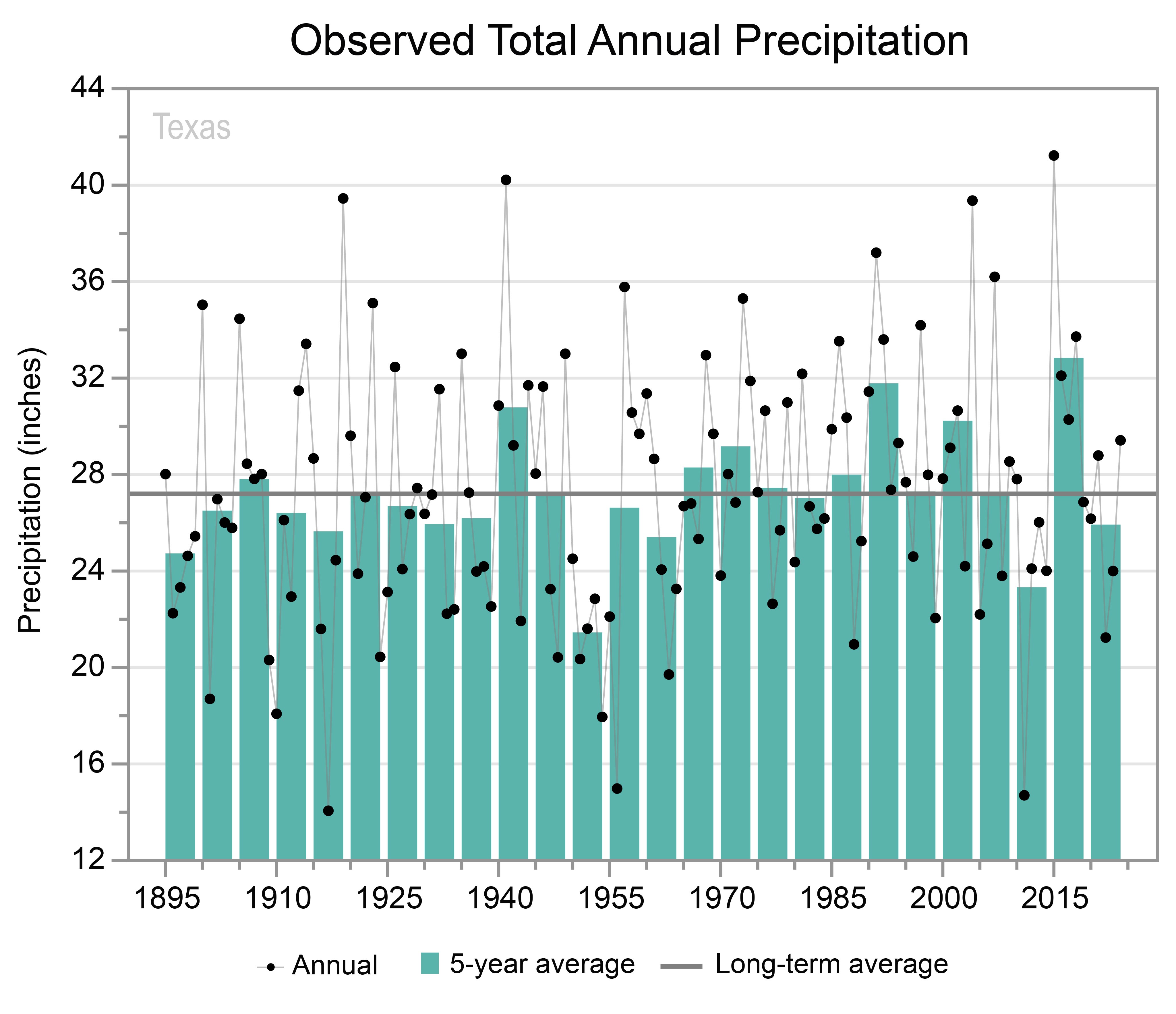
Graph of the observed total annual precipitation for Texas from 1895 to 2024 as described in the caption.
Y-axis values range from 12 to 44 inches. Annual values show year-to-year variability and range from 14.1 to 41.2 inches. Five-year values also show variability and are all near or below the long-term average of 27.2 inches between 1895 and 1964 except for the 1905 to 1909 and 1940 to 1944 periods. Since 1965, 5-year values are all near or above average except for the 2010 to 2014 and 2020 to 2024 periods. The 1950 to 1954 period has the lowest 5-year value at 21.5 inches, and the 2015 to 2020 period has the highest at 32.8 inches.

Graph of the observed annual number of 3-inch extreme precipitation events for Texas from 1900 to 2024 as described in the caption.
Y-axis values range from 0.0 to 3.0 events. Annual values show year-to-year variability and range from 0.2 to 2.7 events. Five-year values also show variability and are all above the long-term average of 0.9 events between 1895 and 1914 but are all near or below average between 1915 and 1989 except for the 1970 to 1974 period. Since 1990, 5-year values are all above average except for the 2005 to 2009, 2010 to 2014, and 2020 to 2024 periods. The 1930 to 1934 period has the lowest 5-year value at 0.6 events, and the 2015 and 2019 period has the highest at 1.6 events.

Map of southeastern Texas showing cumulative 7-day rainfall totals from Hurricane Harvey during August 24 to 31, 2017, as described in the caption.
A color-coded legend shows the quantitative precipitation estimation totals in inches and millimeters, ranging from 0 to more than 51 inches (0 to 1,300 millimeters). Areas closest to the southeastern coast of Texas saw the highest totals, ranging from about 35 inches to 51 inches (900 to 1,300 millimeters). Areas farther north and west, including the Houston area, saw totals ranging from about 12 to 28 inches (300 to 700 millimeters).
Texas consistently ranks in the top 10 states affected by extreme events. In 2024, there were 27 weather and climate disasters in the US that caused at least $1 billion in damages, and 20 of those had impacts in Texas—a new record for the state. Sixteen of the 20 events were severe storms. Between 1995 and 2024, Texas averaged 133 tornadoes and 4 tornado fatalities per year. Tornadoes can occur throughout the year, although activity typically peaks between April and June. Thunderstorms can also bring damaging hail, such as the April 28, 2021, storm that dropped large hail between Del Rio and San Antonio, including a state-record stone measuring 6.4 inches. Other impactful extreme events in Texas include winter storms, extreme heat, and wildfires. The summer of 2011 was the state’s warmest and driest on record and had the highest number of days with temperatures of 100°F or more. During that summer, the Dallas–Fort Worth area endured 40 consecutive days with temperatures of 100˚F or higher—the second-longest streak on record (1899–2024), creating dangerous risks to health. Heat absorbed and emitted by buildings and pavement, as well as other aspects of urban environments, makes cities even warmer than the surrounding countryside, a phenomenon known as the urban heat island effect. The extreme heat and dry conditions of the 2011 summer also helped fuel the worst wildfire season since statewide records began (in approximately 1990), with nearly 4 million acres burned. In February 2021, a widespread winter storm and remarkably cold temperatures caused a spike in power demand, leading to widespread multiday blackouts. At the peak, more than 10 million people were without power, and freezing rain led to impassible roads and traffic fatalities. Ultimately, the storm resulted in more than 200 deaths across the state.
Texas is also at risk for catastrophic damage from tropical cyclones, including coastal flooding caused by storm surges. Between 1900 and 2024, Texas endured 121 tropical storms and hurricanes, approximately half of which (59) were hurricanes (Figure 7). Since 2000, Texas has experienced 28 named storms, including multiple destructive hurricanes, with Hurricane Harvey (Category 4), Hurricane Rita (Category 3), and Hurricane Ike (Category 2) causing the most significant damage. Hurricane Rita caused the second-largest evacuation in US history, and Hurricane Harvey was the costliest hurricane in Texas history, with an estimated $160 billion in damages (adjusted for inflation). More recently, Hurricane Beryl made US landfall on the Texas coast on July 8, 2024. Beryl caused widespread wind damage and spawned more than 50 tornadoes across eastern Texas, western Louisiana, and southern Arkansas. The number of landfalling Atlantic hurricanes is not expected to rise. However, rainfall rates from such storms, as well as the proportion of time they spend as major hurricanes, are projected to increase. The risk of storm surge flooding along the Texas coast is expected to increase in the future due to a combination of sea level rise, land subsidence, the loss of coastal wetlands, and strengthening hurricanes.

Graph of the total number of hurricane events for Texas from 1900 to 2024 as described in the caption.
Y-axis values range from 0 to 7 events. Five-year totals show variability across the period of record and range from 0 to 6 events, with the majority of 5-year totals at 1 or 2 events. Texas experienced hurricane events during every 5-year period except for 1975 to 1979, 1990 to 1994, and 2010 to 2014. The 1940 to 1944 period saw the highest total of 6 events, while the 1930 to 1934, 1985 to 1989, and 2020 to 2024 periods saw the second-highest total of 5 events each.
Droughts are a natural part of the state’s climate. Significant droughts occurred in Texas in the late 1910s, early 1950s, and early 2010s. Paleoclimatic records indicate that droughts as severe as those in 1956 and 2011 have occurred occasionally over the past 1,000 years (Figure 8). The intensity of droughts is projected to increase due to higher temperatures and the associated increase in evaporation rates and soil moisture loss. Due to rapid population growth, especially in urban areas, rising demand for limited water supplies is projected to increase Texas’s vulnerability to drought events. Higher temperatures and drought conditions are also expected to increase the severity, frequency, and extent of wildfires, threatening significant harm to property, human health, and livelihoods.

Line graph of the Texas Palmer Drought Severity Index for the years 1000 to 2024 as described in the caption.
Y-axis values are divided into dry and wet categories, ranging from 0 to negative 8 (dry) and 0 to positive 8 (wet). Annual values show variability and range from negative 6.2 to positive 5.8. Annual values for most years fall between negative 2 and positive 2, but values reaching negative 3 and positive 3 are common. The 20-year running average also shows variability, with values ranging from negative 1.6 to positive 1.1. Since the beginning of the modern era (red line), the running average is generally low in the negative range until the 1920s, then fluctuates above and below 0 until peaking in 1977 at positive 0.8. Since the 2000s, the running average shows a decline, reaching a low of negative 1.3 in 2014.
Under the intermediate and higher emissions pathways, historically unprecedented warming is projected during this century (Figure 1). Even under the lower emissions pathway, most projections show annual average temperatures exceeding historical levels by the middle of the century. However, projections for all three pathways show a large range of potential temperature increases, and some projections for the lower pathway are comparable to recent observed values. Heat wave intensity is projected to increase, while the intensity of cold waves is projected to decrease.
Under the intermediate emissions pathway, projections indicate decreases in annual precipitation across Texas by midcentury; however, the projected changes are not statistically significant (Figure 9). There is similar uncertainty in the projections for seasonal precipitation, although models generally indicate increases and decreases across the state in all seasons. The frequency and intensity of extreme precipitation events are projected to increase, potentially increasing the frequency and intensity of floods.

Map of the contiguous United States showing the projected changes in total annual precipitation by the middle of this century as described in the caption. The state of Texas is outlined in black.
Legend values range from less than negative 10 to greater than positive 15 percent. Note: unless otherwise specified, projected values are not statistically significant.
Texas
The majority of Texas is projected to see decreases in total annual precipitation of up to 5 percent, with a small portion of the northeastern corner expected to see increases of up to 5 percent.
Contiguous US
Projected increases in total annual precipitation are as follows: up to 5 percent for most of the Southeast, as well as the central Midwest, central Great Plains, central West, and Northwest; and 5 to 10 percent for all of the Northeast, as well as portions of the Mid-Atlantic, Southeast, northern Midwest, northern Great Plains, and Pacific Northwest, with statistically significant increases in the 5 to 10 percent range for the Northeast, northeastern Midwest, and portions of the northern Great Plains and Pacific Northwest.
Projected decreases of up to 5 percent are expected across most of Texas, New Mexico, and Arizona, as well as southern California.
Texas is at considerable risk from sea level rise. On average, the state experienced about 12 inches of sea level rise between 1970 and 2020—compared to 6 inches for the contiguous US as a whole—and projections under the Intermediate sea level scenario show additional increases of about 12 inches by 2050 and 1.8 feet by 2070 (Figure 10). Across the five scenarios shown in Figure 10, the projected increases from 2020 to 2070 range from about 1 to 4 feet. Rising sea levels pose a threat to the state’s coastal communities, infrastructure, and ecosystems. These risks are increased due to land subsidence (sinking) along parts of the Texas coastline.

Two time series of observed and projected relative sea level change for (a) the contiguous US and (b) Texas from 1970 to 2070 as described in the caption.
Y-axis values range from negative 1 to positive 5 feet for both graphs. Legends in both graphs denote sources of historical data and scenarios for projections. Line colors for historical data are black for tide gauge data and orange for satellite data. Line and shading colors for projections based on five scenarios are as follows: light blue, Low; medium blue, Intermediate-Low; dark blue, Intermediate; yellow, Intermediate-High; and dark orange, High.
Panel A: Contiguous US
Tide gauge and satellite data generally show increases but with year-to-year variability. Projected data show increases under all scenarios. Tide gauge values range from a minimum of negative 0.3 feet in 1976 to a maximum of positive 0.4 feet in 2023. Satellite values range from a minimum of 0.0 feet in 1994 to a maximum of 0.4 feet in 2023. Projected sea level median values (lines) for the Low scenario range from 0.3 feet in 2020 to 1.1 feet in 2070, compared to 0.4 feet in 2020 to 3.1 feet in 2070 for the High scenario. Likely ranges (shading) become wider over the period shown. The ranges of likely values in 2070 for each of the five scenarios are as follows: Low scenario, from 0.9 to 1.4 feet; Intermediate-Low, 1.2 to 1.7 feet; Intermediate, 1.5 to 2.2 feet; Intermediate-High, 1.8 to 3.1 feet; and High, 2.4 to 3.8 feet.
Panel B: Texas
The tide gauge line shows an increase slightly higher than that in the contiguous US graph, while the satellite line shows a lower increase. All future scenario lines show increases higher than those in the contiguous US graph. Tide gauge values range from a minimum of negative 0.5 feet in 1970 to a maximum of positive 0.7 feet in 2020. Satellite values range from a minimum of 0.0 feet in 1997 to a maximum of 0.5 feet in 2020. Projected sea level median values (lines) for the Low scenario range from 0.5 feet in 2020 to 1.7 feet in 2070, compared to 0.5 feet in 2020 to 3.8 feet in 2070 for the High scenario. Likely ranges (shading) become wider over the period shown. The ranges of likely values in 2070 for each of the five scenarios are as follows: Low scenario, from 1.5 to 1.9 feet; Intermediate-Low, 1.7 to 2.2 feet; Intermediate, 2.0 to 2.8 feet; Intermediate-High, 2.4 to 3.7 feet; and High, 3.0 to 4.5 feet.
Sea level rise has caused an increase in high-tide floods associated with nuisance-level impacts, which are occurring more frequently, even on sunny days. High-tide flooding occurs when one or more factors—sea level rise, winds, changes in ocean currents, full or new moons—push water levels above the normal high-tide mark. These events can damage infrastructure, cause road closures, and overwhelm storm drains. High-tide flooding has increased in all US coastal areas, with more rapid increases along the East and Gulf Coasts, and is likely to occur more frequently in Texas as global and local sea levels continue to rise. The number of high-tide flood days has increased at Port Isabel, with the greatest number occurring in 2020 (Figure 11). Under both the Intermediate-Low and Intermediate scenarios, high-tide floods are projected to occur much more frequently in future years.
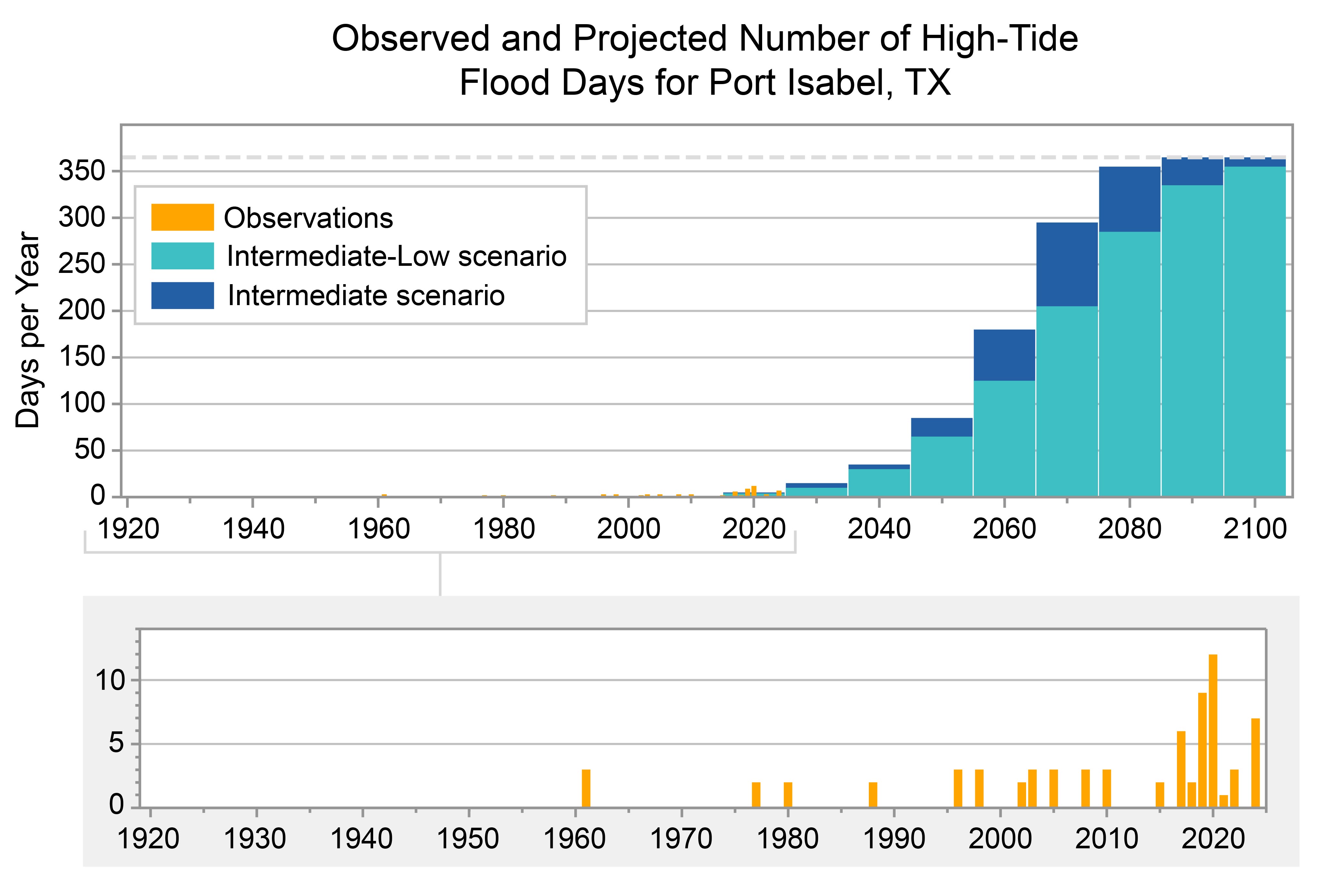
Graph of the observed and projected annual number of high-tide flood days at Port Isabel, Texas, from 1944 to 2100 (top), including a magnified view of the observed data for the period 1944 to 2024 (bottom), as described in the caption.
A legend shows annual observations (orange bars) and projected 19-year averages (two-colored bars) for the Intermediate-Low (medium blue) and Intermediate (dark blue) sea level scenarios.
Bottom
Y-axis labels for the magnified view range from 0 to 10 days per year. Following the first recorded event in 1961, high-tide flooding was sporadic until the mid-2010s, often with gaps of 1 to 3 (and occasionally up to 12) years between events and annual values mostly below 4 days. Starting in 2017, high-tide flood days occurred every year except for 2023, with a record high of 12 days in 2020.
Top
Y-axis labels range from 0 to 350 days, with a horizontal dashed gray line indicating 365 days. Port Isabel is projected to experience 65 to 85 high-tide flood days per year by 2050 under the Intermediate-Low and Intermediate scenarios, respectively, and 355 to 365 days by 2100.
SOURCES
- CO-OPS, n.d.: Tides & Currents. National Oceanic and Atmospheric Administration, Center for Operational Oceanographic Products and Services, accessed July 25, 2025. https://tidesandcurrents.noaa.gov
- Edwards, R., n.d.: The Online Tornado FAQ. National Oceanic and Atmospheric Administration, Storm Prediction Center, Norman, OK, last modified December 16, 2024, accessed July 25, 2025. https://www.spc.noaa.gov/faq/tornado/
- Hoerling, M., A. Kumar, R. Dole, J.W. Nielsen-Gammon, J. Eischeid, J. Perlwitz, X.-W. Quan, T. Zhang, P. Pegion, and M. Chen, 2013: Anatomy of an extreme event. Journal of Climate, 26 (9), 2811–2832. https://doi.org/10.1175/JCLI-D-12-00270.1
- HRD, n.d.: Continental United States Hurricane Impacts/Landfalls 1851–2019. National Oceanic and Atmospheric Administration, Hurricane Research Division, Atlantic Oceanographic and Meteorological Laboratory, Miami, FL, last modified September 2025, accessed July 25, 2025. http://www.aoml.noaa.gov/hrd/hurdat/All_U.S._Hurricanes.html
- Kunkel, K.E., L.E. Stevens, S.E. Stevens, L. Sun, E. Janssen, D. Wuebbles, M.C. Kruk, D.P. Thomas, M.D. Shulski, N.A. Umphlett, K.G. Hubbard, K. Robbins, L. Romolo, A. Akyuz, T.B. Pathak, T.R. Bergantino, and J.G. Dobson, 2013: Regional Climate Trends and Scenarios for the U.S. National Climate Assessment Part 4. Climate of the U.S. Great Plains. NOAA Technical Report NESDIS 142-4. National Oceanic and Atmospheric Administration, National Environmental Satellite, Data, and Information Service, Washington, DC, 91 pp. https://repository.library.noaa.gov/view/noaa/56809
- Martinaitis, S.M., S.B. Cocks, A.P. Osborne, M.J. Simpson, L. Tang, J. Zhang, and K.W. Howard, 2021: The historic rainfalls of Hurricanes Harvey and Florence: A perspective from the Multi-Radar Multi-Sensor system. Journal of Hydrometeorology, 22 (3), 721–738. https://doi.org/10.1175/JHM-D-20-0199.1
- Masters, J., C.C. Burt, and B. Henson, 2025: The deadliest floods in U.S. history. Yale Climate Connections, July 28, 2025. Yale University, Yale Center for Environmental Communication. https://yaleclimateconnections.org/2025/07/the-deadliest-floods-in-u-s-history
- NCEI, 2023: The Great Texas Freeze: February 11–20, 2021. NCEI News, February 24, 2023. National Oceanic and Atmospheric Administration, National Centers for Environmental Information. https://www.ncei.noaa.gov/news/great-texas-freeze-february-2021
- NCEI, n.d.: Billion-Dollar Weather and Climate Disaster: Tropical Cyclone Events [Texas 1980–2024]. National Oceanic and Atmospheric Administration, National Centers for Environmental Information, Asheville, NC, accessed July 25, 2025. https://www.ncei.noaa.gov/access/billions/events/TX/1980-2024/?disasters%5B%5D=tropical-cyclone
- NCEI, n.d.: Climate at a Glance. National Oceanic and Atmospheric Administration, National Centers for Environmental Information, accessed July 25, 2025. https://www.ncei.noaa.gov/access/monitoring/climate-at-a-glance/
- NCEI, n.d.: National Climate Report. National Oceanic and Atmospheric Administration, National Centers for Environmental Information, accessed July 25, 2025. https://www.ncei.noaa.gov/access/monitoring/monthly-report/national
- NCEI, n.d.: State Climate Extremes Committee (SCEC) Records—Texas. National Oceanic and Atmospheric Administration, National Centers for Environmental Information, accessed July 25, 2025. https://www.ncei.noaa.gov/access/monitoring/scec/records/tx/all
- NCEI, n.d.: U.S. Climate Normals. National Oceanic and Atmospheric Administration, National Centers for Environmental Information, accessed July 25, 2025. https://www.ncei.noaa.gov/products/land-based-station/us-climate-normals
- NDMC, n.d.: U.S. Drought Monitor: Data Tables. National Drought Mitigation Center, Lincoln, NE, accessed July 25, 2025. https://droughtmonitor.unl.edu/DmData/DataTables.aspx
- Needham, H.F. and B.D. Keim, 2012: A storm surge database for the US Gulf Coast. International Journal of Climatology, 32 (14), 2108–2123. https://doi.org/10.1002/joc.2425
- Needham, H.F., B.D. Keim, D. Sathiaraj, and M. Shafer, 2012: Storm surge return periods for the United States Gulf Coast. In: World Environmental and Water Resources Congress 2021. Albuquerque, NM, May 20–24, 2012. American Society of Civil Engineers, 2422–2463. https://doi.org/10.1061/9780784412312.245
- NHC, n.d.: Historical Hurricane Tracks. National Oceanic and Atmospheric Administration, National Hurricane Center, Miami, FL, accessed July 25, 2025. https://coast.noaa.gov/hurricanes
- NHC, n.d.: NHC Data Archive. National Oceanic and Atmospheric Administration, National Hurricane Center, Miami, FL, accessed July 25, 2025. http://www.nhc.noaa.gov/data/
- Nielsen-Gammon, J.W., 2011: The 2011 Texas Drought: A Briefing Packet for the Texas Legislature. Texas A&M University, College of Geosciences, Office of the State Climatologist, College Station, TX, 43 pp. https://hdl.handle.net/1969.1/158245
- NSSL, n.d.: Warn-On-Forecast Case Studies: Large Hail Strikes Three Cities, April 28, 2021. National Oceanic and Atmospheric Administration, National Severe Storms Laboratory, accessed July 25, 2025. https://www.nssl.noaa.gov/projects/wof/casestudies/hail-oktx-apr2021
- NWS, 2015: Weather Event Summary: 2015 Memorial Day Weekend Flooding 23–24 May 2015. National Oceanic and Atmospheric Administration, National Weather Service, Austin/San Antonio Weather Forecast Office, Austin/San Antonio, TX, 32 pp. https://www.weather.gov/media/ewx/wxevents/ewx-20150524.pdf
- NWS, n.d.: DFW—Annual and Consecutive 100° Days. National Oceanic and Atmospheric Administration, National Weather Service, Fort Worth/Dallas Weather Forecast Office, Fort Worth/Dallas, TX, accessed July 25, 2025. https://www.weather.gov/fwd/danncon10
- NWS, n.d.: Storm Prediction Center: Severe Weather Maps, Graphics, and Data Page. National Oceanic and Atmospheric Administration, National Weather Service, Storm Prediction Center, Norman, OK, accessed July 25, 2025. https://www.spc.noaa.gov/wcm/
- OCM, n.d.: U.S. Sea Level Change: National Sea Level Explorer. National Oceanic and Atmospheric Administration, Office for Coastal Management, accessed July 25, 2025. https://earth.gov/sealevel/us/national-sea-level-explorer
- Roth, D., 2010: Texas Hurricane History. National Oceanic and Atmospheric Administration, National Weather Service, Camp Springs, MD, 83 pp. https://www.wpc.ncep.noaa.gov/research/txhur.pdf
- Sweet, W., G. Dusek, J. Obeysekera, and J. Marra, 2018: Patterns and Projections of High Tide Flooding Along the U.S. Coastline Using a Common Impact Threshold. NOAA Technical Report NOS CO-OPS 086. National Oceanic and Atmospheric Administration, National Ocean Service, Center for Operational Oceanographic Products and Services, Silver Spring, MD, 56 pp. https://tidesandcurrents.noaa.gov/publications/techrpt86_PaP_of_HTFlooding.pdf
- Sweet, W.V., B.D. Hamlington, R.E. Kopp, C.P. Weaver, P.L. Barnard, D. Bekaert, W. Brooks, M. Craghan, G. Dusek, T. Frederikse, G. Garner, A.S. Genz, J.P. Krasting, E. Larour, D. Marcy, J.J. Marra, J. Obeysekera, M. Osler, M. Pendleton, D. Roman, L. Schmied, W. Veatch, K.D. White, and C. Zuzak, 2022: Global and Regional Sea Level Rise Scenarios for the United States: Updated Mean Projections and Extreme Water Level Probabilities Along U.S. Coastlines. NOAA Technical Report NOS 01. National Oceanic and Atmospheric Administration, National Ocean Service, Silver Spring, MD, 111 pp. https://earth.gov/sealevel/us/internal_resources/756/noaa-nos-techrpt01-global-regional-SLR-scenarios-US.pdf
- TXGLO, n.d.: 2015 Floods & Storms. Texas General Land Office, Austin, TX, accessed July 25, 2025. https://www.glo.texas.gov/disaster-recovery/2015-floods-storms
- USGCRP, 2017: Climate Science Special Report: Fourth National Climate Assessment, Volume I. Wuebbles, D.J., D.W. Fahey, K.A. Hibbard, D.J. Dokken, B.C. Stewart, and T.K. Maycock, Eds. U.S. Global Change Research Program, Washington, DC, USA, 470 pp. https://repository.library.noaa.gov/view/noaa/19486
- USGCRP, 2018: Impacts, Risks, and Adaptation in the United States: Fourth National Climate Assessment, Volume II. Reidmiller, D.R., C.W. Avery, D.R. Easterling, K.E. Kunkel, K.L.M. Lewis, T.K. Maycock, and B.C. Stewart, Eds. U.S. Global Change Research Program, Washington, DC, USA, 1515 pp. https://repository.library.noaa.gov/view/noaa/19487
- USGCRP, 2023: Fifth National Climate Assessment. Crimmins, A.R., C.W. Avery, D.R. Easterling, K.E. Kunkel, B.C. Stewart, and T.K. Maycock, Eds. U.S. Global Change Research Program, Washington, DC, USA. https://repository.library.noaa.gov/view/noaa/61592